
Case Study: How a Pune Retailer Saved 40% on Billing Time
A representative case study showing how a 3-store telecom retailer in Pune cut billing time by 40%, recovered missed scheme claims, and eliminated IMEI errors with RetailerOS.
Overview
This is a representative case study based on composite results from telecom retailers who have implemented RetailerOS. While the specific business described is illustrative, the metrics and outcomes reflect typical results observed across similar retail operations.
The Retailer: A Growing Multi-Store Operation in Pune
The subject is a multi-brand telecom retailer operating 3 stores across Pune — one in Deccan Gymkhana, one near Hinjewadi IT Park, and one in Kothrud. The business sells smartphones, accessories, and provides recharge services across Samsung, Vivo, Oppo, Xiaomi, Realme, OnePlus, and Apple.
Combined monthly revenue across the three stores: approximately Rs. 75-85 lakh. The team includes 3 store managers, 12 sales staff, and 2 back-office employees handling accounts, inventory, and compliance.
The business had been growing steadily — the third store was opened just 8 months ago. But growth was exposing cracks in the operational foundation that had worked well enough with a single store.
The Before State: Tally, Excel, and WhatsApp
Billing and Invoicing Billing was done through Tally ERP 9 with a custom configuration for GST-compliant invoicing. Tally handled the financial side well enough, but it was never designed for telecom-specific workflows. IMEI numbers were entered manually as a line item description — there was no structured IMEI field, no barcode scanning integration, and no way to search or report on IMEI data after the fact. Average time to complete a single smartphone sale (from product selection to printed invoice): 8-10 minutes. During peak hours on weekends and festive days, customers waited 15-20 minutes for billing. ### IMEI Tracking IMEI records were maintained in a separate Excel sheet — one file per store, updated daily (in theory). In practice, the Excel was updated in batches every 2-3 days. This created a rolling window of discrepancy where the billing system and the IMEI register were out of sync. During a routine stock audit, the retailer found 23 IMEI discrepancies across 3 stores — devices that were billed but not recorded, recorded but not billed, or recorded against the wrong model. Resolving each discrepancy took 30-45 minutes of cross-referencing invoices, distributor records, and physical stock. ### Scheme Management Brand schemes were tracked using a combination of WhatsApp group messages (where brand managers posted updates), a shared Google Sheet (where the owner tried to consolidate active schemes), and memory (where salespersons recalled which schemes to apply). The owner estimated that the business was missing Rs. 30,000-40,000 per month in unclaimed scheme payouts. The biggest losses came from: - Volume slab schemes where the business fell just short of the next tier because no one was tracking the running count across stores - Per-unit cashback schemes where claims were submitted late or with incomplete documentation - Exchange schemes where the trade-in incentive wasn't properly logged ### Daily Reconciliation The owner spent 45 minutes to 1 hour every evening reconciling the day's sales across Tally, the Excel IMEI register, and the cash/UPI collection records. On weekends, this stretched to 90 minutes. Monthly closing — reconciling scheme claims, distributor payments, and GST filings — took 4-5 full working days. ### GST Compliance GST returns were prepared by an external chartered accountant who received data exports from Tally. But because Tally invoices didn't always capture HSN codes correctly for accessories and combo sales, the CA regularly flagged errors that required manual correction. GST audit time was a source of constant stress — the owner described it as "always feeling one notice away from a problem."
The Decision to Switch
The tipping point came when the business lost approximately Rs. 45,000 in a single month from a Samsung volume scheme. The business had sold 46 units of Samsung A-series across all 3 stores — 4 units short of the 50-unit slab that would have unlocked a Rs. 45,000 bonus. No one had visibility into the aggregate count across stores until the scheme period ended.
"That Rs. 45,000 loss was on a scheme we were actively selling against," the owner noted. "We just didn't know where we stood. That's when I started looking for software built specifically for this business."
The retailer evaluated three options: a telecom-specific POS system from a national provider, a customized Zoho implementation, and RetailerOS from Khosha Systems. The decision came down to two factors: RetailerOS had a purpose-built scheme engine and the implementation timeline was 2 weeks rather than 2 months.
Implementation: A 2-Week Rollout
Week 1: Setup and Data Migration
The RetailerOS team configured the system for all 3 stores, including: - Product catalog setup with brand, model, variant, and IMEI fields - Active scheme configuration for all 6 major brands (38 active schemes at the time) - Existing inventory import with IMEI mapping (approximately 1,200 devices across 3 stores) - GST configuration with correct HSN codes for phones, accessories, and services - User accounts for all 17 staff members with role-based access
Historical data from Tally (past 12 months of invoices) was imported for continuity of customer records and financial reporting.
Week 2: Training and Parallel Run
All staff received hands-on training — store managers got 4 hours, sales staff got 2 hours, and the back-office team got a full day focused on scheme management, reporting, and GST workflows.
During the second week, both systems ran in parallel. Sales were billed in RetailerOS and cross-checked against Tally. By the end of the parallel run, the team was confident enough to go live exclusively on RetailerOS.
Total implementation cost including setup, data migration, training, and the first month's license: under Rs. 40,000. The ongoing monthly cost for 3 stores: approximately Rs. 8,000-12,000.
The After State: 90 Days Post-Implementation
Billing Time: 40% Reduction The most immediately noticeable change. Average billing time per smartphone sale dropped from 8-10 minutes to 4.5-6 minutes. The improvement came from three factors: 1. Integrated IMEI scanning. Instead of manually typing a 15-digit IMEI number into a Tally description field, staff scan the barcode on the device box. The IMEI is captured, validated, and linked to the invoice automatically. 2. Auto-applied schemes. Instead of the salesperson manually calculating which scheme applies and adjusting the price, RetailerOS identifies and applies all eligible schemes automatically. The salesperson confirms the final price — they don't compute it. 3. Customer record lookup. Returning customers are identified by phone number. Their purchase history, previous devices, and applicable exchange values are available instantly — no searching through old invoices. During peak hours, the reduced billing time translated to 2-3 additional customers served per store per day. At an average transaction value of Rs. 15,000, that's Rs. 45,000-90,000 in additional daily revenue capacity across 3 stores. ### Scheme Recovery: Rs. 65,000 in the First Month In the first full month on RetailerOS, the business recovered Rs. 65,000 in scheme payouts that would have been missed under the old system. The breakdown: - Rs. 28,000 from hitting a Vivo volume slab. The real-time slab tracker showed the team was 5 units short with 4 days remaining — they focused selling effort and hit the target. - Rs. 22,000 from per-unit cashback claims that were auto-generated and submitted on time with complete documentation. - Rs. 15,000 from exchange scheme incentives that were now properly captured and claimed. Over 90 days, total additional scheme recovery: approximately Rs. 1.8 lakh. This alone represented a 15x return on the implementation cost. ### IMEI Discrepancies: Zero After the first month on RetailerOS, the next stock audit found zero IMEI discrepancies. Every device in stock had a matching system record. Every sold device had an IMEI linked to an invoice. Every inter-store transfer was logged with IMEI-level detail. The 2 back-office hours previously spent weekly on IMEI reconciliation were eliminated entirely. ### Daily Reconciliation: From 45 Minutes to 10 Minutes End-of-day reconciliation went from a 45-minute manual exercise to a 10-minute dashboard review. Because billing, IMEI tracking, scheme application, and payment collection all happen in the same system, there's nothing to cross-reference. The day's numbers either match or they don't — and if they don't, the discrepancy is flagged automatically with the specific transaction that caused it. Monthly closing — which previously consumed 4-5 working days — now takes less than a full day. ### GST Compliance: Audit-Ready at All Times GST returns are now generated directly from RetailerOS with correct HSN codes, proper tax calculations, and complete invoice trails. The chartered accountant's review time dropped from 2 days to 3 hours. The owner's description: "For the first time, I'm not anxious about a GST notice."
Summary of Results
| Metric | Before (Tally + Excel) | After (RetailerOS) | Improvement |
|---|---|---|---|
| Billing time per sale | 8-10 minutes | 4.5-6 minutes | 40% reduction |
| IMEI discrepancies per audit | 20-25 | 0 | 100% elimination |
| Missed scheme claims | Rs. 30-40K/month | Near zero | Rs. 65K recovered in Month 1 |
| Daily reconciliation time | 45-60 minutes | 10 minutes | 80% reduction |
| Monthly closing time | 4-5 days | Less than 1 day | 75% reduction |
| GST filing errors | 5-8 per quarter | 0 | 100% elimination |
| Implementation time | — | 2 weeks | — |
| Monthly cost (3 stores) | — | Rs. 8-12K | — |
Key Takeaways for Telecom Retailers
This case study illustrates several patterns we see consistently across telecom retail operations:
1. Scheme revenue recovery pays for the software many times over. The Rs. 1.8 lakh recovered in scheme claims over 90 days dwarfed the total cost of implementation and licensing. For most retailers, scheme recovery alone justifies the investment.
2. IMEI tracking must be integrated into billing — not maintained separately. Any system where IMEI records live outside the billing workflow will eventually have discrepancies. The only reliable approach is capturing IMEI at the point of sale, automatically, every time.
3. Speed at the billing counter directly impacts revenue. In a retail environment where customers can walk to a competitor two shops away, reducing billing time isn't just about efficiency — it's about capturing sales you'd otherwise lose.
4. Compliance confidence reduces operational stress. The psychological burden of worrying about GST audits and IMEI mismatches is real. Automated, accurate record-keeping eliminates an entire category of business anxiety.
5. Implementation doesn't have to be painful. A 2-week rollout with parallel running is achievable when the software is purpose-built for the domain. Lengthy implementation timelines usually indicate the software is being forced to fit a use case it wasn't designed for.
Is Your Retail Operation Facing Similar Challenges?
If you recognize the pain points described in this case study — manual IMEI tracking, missed scheme claims, slow billing, GST stress — the problems won't improve on their own. As your business grows and adds stores, every manual process multiplies.
RetailerOS was built specifically for telecom and electronics retailers who need IMEI tracking, scheme management, and GST compliance in a single integrated system. Whether you operate 1 store or 15, the platform scales with your business.
We also offer Real Desk — a connected sales suite for real estate developers, brokers, and site visitor management — built with the same philosophy of purpose-built, domain-specific software.
Get in touch to see how RetailerOS can deliver similar results for your business. We'll walk you through a demo using your actual product catalog and brand schemes.
More from Our Blog
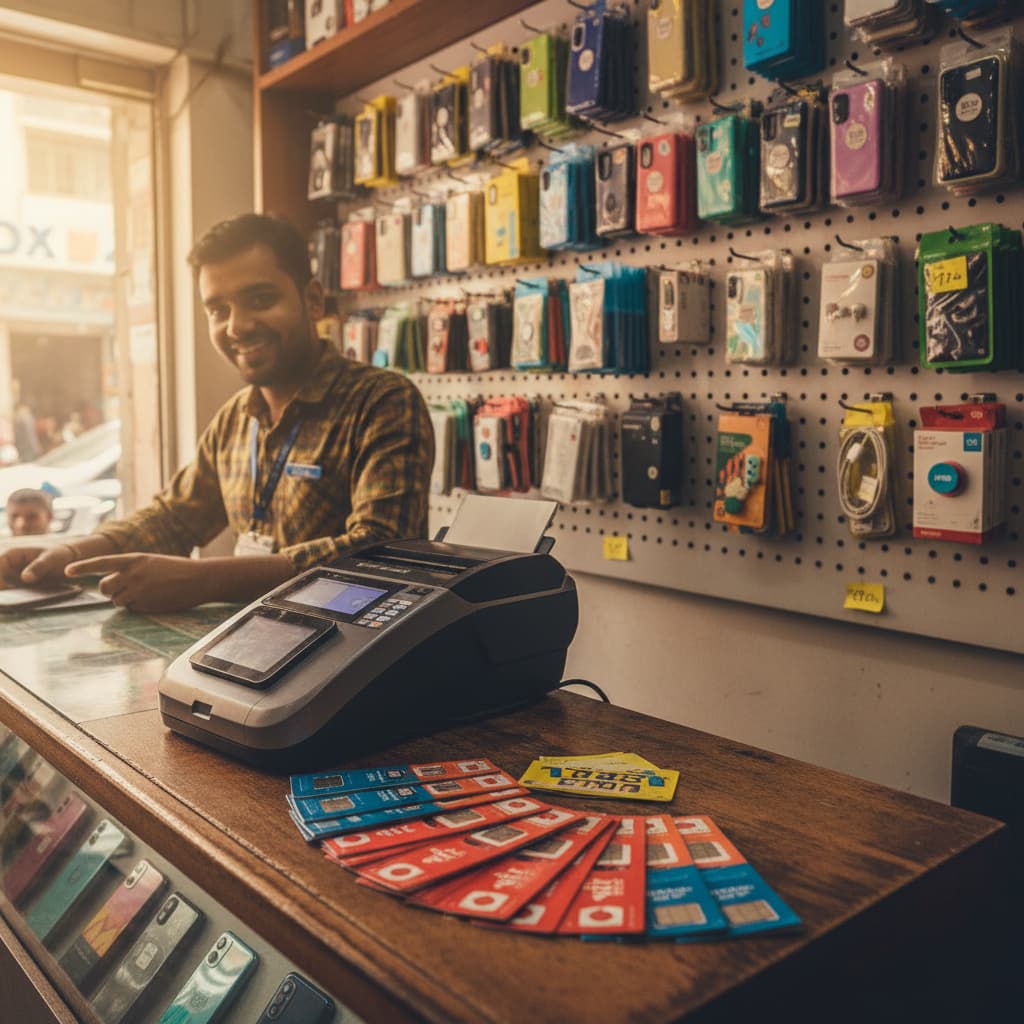
Why Telecom & Electronics Retailers in India Need Purpose-Built Software in 2026
Generic POS and billing software wasn't designed for IMEI tracking, brand scheme management, or serial-number-level inventory. Here's what telecom and consumer electronics retailers should look for in a retail management platform.
How to Choose the Right Real Estate CRM in India (2026 Guide)
A comprehensive guide to evaluating and selecting a CRM for Indian real estate developers and brokers. Covers RERA compliance, lead management from property portals, and the features that actually matter.