RetailerOSa product of Khosha Systems

Built for India

Why we built RetailerOS.

India has around 1.5 lakh mobile and consumer-electronics retailers. They put a phone in every hand, and most of them run the counter on a paper register and a spreadsheet. We built them an operating system. This is the reasoning behind it, and what it took.

retaileros.in is where the product is sold. This page is about why it exists.

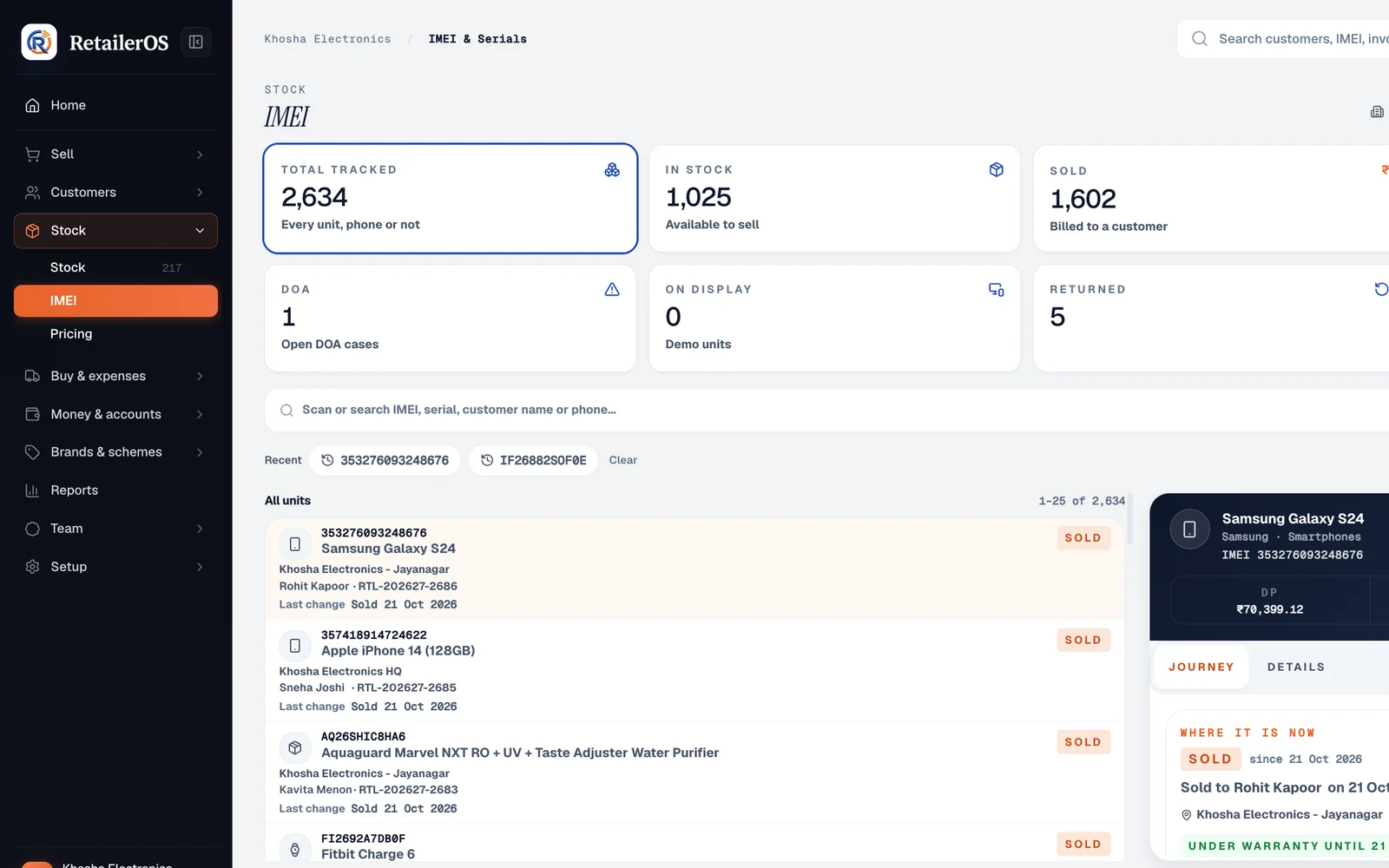
RetailerOS IMEI and serials: tracked, in stock, sold and returned units, with one unit’s journey open (amounts hidden)
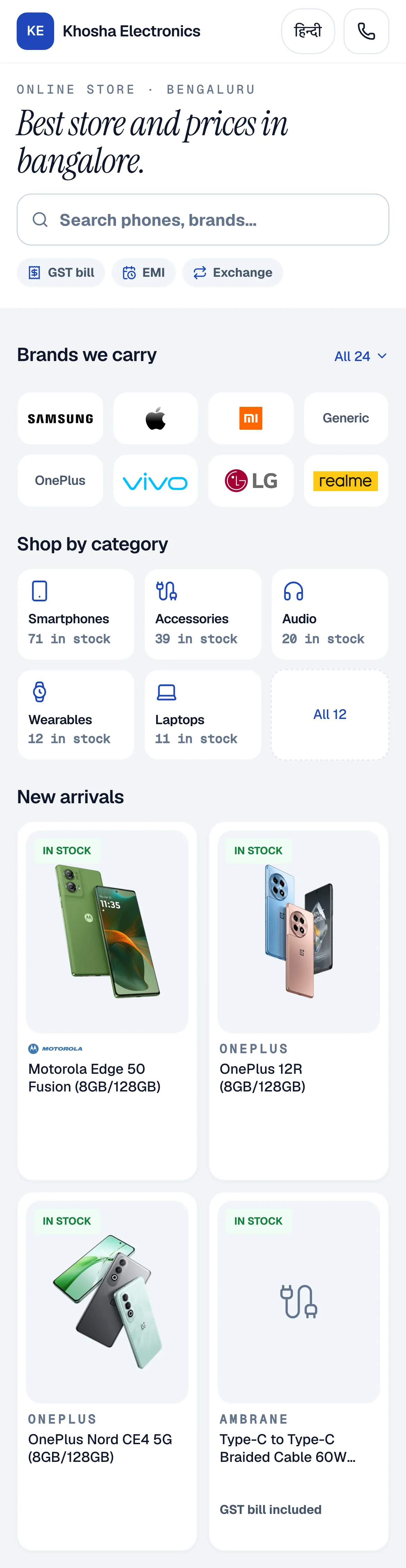
RetailerOS online store on a phone: the brands the shop carries, categories with stock counts and new arrivals

IMEI & serial lifecycleEvery unit, from purchase to service

Mobile and consumer-electronics counters across India, from metro malls to a single shop in a small town.

Khosha Systems estimate, 2026.

The counter in every neighbourhood puts a phone in every hand.

The phone is the essential tool of modern India. It is the bank, the ticket, the classroom, the shopfront and the ID card. Almost nobody buys one from a factory. They buy it from a counter near home, from someone who sets it up, moves their chats across, sells the case, handles the exchange and takes the repair when the screen cracks.

Those counters are mostly independent: a family, a few staff, one or two stores, a WhatsApp number and a notebook. They serve the whole country, and the software industry had served almost everyone but them.

DelhiMumbaiKolkataChennaiHyderabadBangalore

Bangalorewhere RetailerOS is built

Every phone has a fifteen-digit name, and nobody tracks it.

A handset is not a SKU. Two identical boxes are two different devices with two IMEIs, two warranties and two histories. Generic billing software treats them as a quantity, so evenings go on matching IMEIs to invoices by hand, and the mismatch is found at the audit, months later.

Before: The IMEI typed into a notes field, or written in the register.
Brand schemes pay the margin, and they live in a spreadsheet.

Samsung, Vivo, Oppo, LG and the banks run cashback, exchange bonuses and target slabs that change by product and by week. The margin on a handset often sits in the scheme rather than the price. Tracked in Excel and reconciled on a Sunday, claims are missed and the money stays with the distributor.

Before: A scheme sheet, a target the floor cannot see, a claim filed late.

A GST bill in thirty seconds, with a queue watching.

Billing at an electronics counter means HSN codes, CGST and SGST, an exchange value, a scheme line and a payment split across UPI and cash, while a customer waits and the next one is at the door. The bill then has to reach the customer, who will ask for it again on WhatsApp in six months.

Before: A printed slip, a photo of it, a search through old chats.

The second store doubles the phone calls.

Once there are two counters, the owner is phoning each one at closing time: what sold, what is in stock, whether the discount was approved. Stock sits in one branch while the customer stands in the other.

Before: Separate books per store, assembled by hand at the end of the month.

The problem was never that retailers refuse software. It was that software had never been written in the shape of their day.
Khosha Systems, on the brief for RetailerOS

What changed.

Four things now exist together that did not ten years ago. They are the reason a counter can be run from a phone, by the retailer, without an IT team.

At the counterBeforeNow
The device ledgerA paper register and a notes fieldEvery unit scanned in by IMEI or serial, tracked from purchase to sale to service
Brand schemesAn Excel sheet reconciled on SundayA scheme catalogue with target tracking, applied on the bill
The billPrinted, filed, asked for againA GST invoice on the customer’s WhatsApp as they pay
The second storeA phone call at closing timeEvery store’s stock, cash and staff on one owner login
  • A smartphone in every pocket

    The retailer’s own phone is a scanner, a camera and a terminal. Software for the counter should run there first, not on a desktop in the back room.

  • WhatsApp as the receipt channel

    Customers already live there. A bill that lands on WhatsApp is never lost and never asked for twice.

  • GST and digital payments

    UPI, HSN codes and structured invoices turned the bill into a record rather than a slip of paper. Software can finally do the arithmetic.

  • Cloud and AI

    One live ledger across every store, and models that draft a festival creative from a sentence. What once needed an IT team is now a subscription.

What we had to build.

Beneath a counter that bills in about thirty seconds there is a system that has to be right every time. The engineering, in the order a device meets it.

  1. Purchase

    Scanned in by IMEI or serial against a purchase order; the supplier is on the record.

    Inventory
  2. Stock

    Held per store, with low-stock and dead-stock flags and a reorder point.

    Stores
  3. Bill

    IMEI captured per line, GST computed, the scheme applied, payment split.

    Sales Desk
  4. Receipt

    Printed on thermal and sent on WhatsApp in the same step.

    WhatsApp
  5. Claim

    The scheme sale becomes a claim with product, IMEI, scheme and amount.

    Schemes
  6. Service

    Repair job cards and warranty sit on the unit’s own history.

    Repairs

One bill, five updates.

What RetailerOS does the moment a sale is rung up, without anyone asking.

Sales Desk · bill #024iPhone 15 Pro, IMEI captured, scheme applied, paid on UPI
  • InventoryThe unit is marked sold against its IMEI.
  • SchemesThe eligible brand cashback is applied and the claim is queued.
  • KhaataThe customer’s ledger is updated.
  • WhatsAppThe GST receipt is delivered to the customer.
  • ReportsToday’s sales, stock and profit are already current.

0.4 seconds from payment to the fifth update. Nobody at the counter has to ask.

01

The IMEI and serial lifecycle.

Every unit is a first-class record from the day it is scanned in: supplier, purchase order, store, the sale it went out on, the customer, the warranty window and any repair that follows. Search an IMEI and you get the chain of custody, whichever branch handled it.

  • Scanned with a barcode gun, the phone camera or typed, with the second IMEI for dual-SIM handsets
  • Tracked, in stock, sold and returned states, held per store
  • Cross-store IMEI search, so a customer at the wrong branch is still your customer
RetailerOS IMEI and serials: tracked, in stock, sold and returned units, with one unit’s journey open (amounts hidden)
02

GST billing in a single scan.

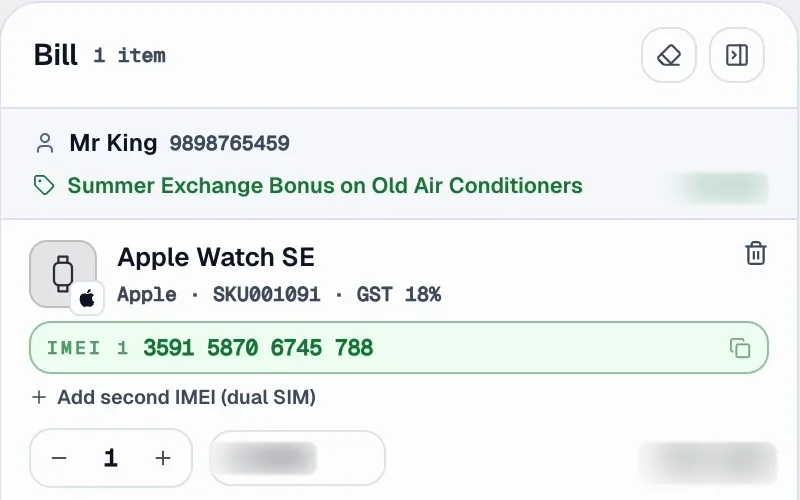
The Sales Desk is built for the fastest billing hand at the counter: scan, sell, print thermal, send on WhatsApp. HSN codes are pre-loaded, CGST and SGST are computed as the bill builds, exchange and scheme lines sit on the same invoice, and payment can be split across UPI, cash, card and khaata.

  • GST-compliant invoices with HSN codes, credit notes and reverse charge
  • IMEI captured per line item; the scheme tagged on the sale
  • Printed on 80 mm or A4, saved as PDF, or delivered on WhatsApp
RetailerOS bill: an Apple Watch SE with its IMEI captured, the customer attached and a brand scheme applied (amounts hidden)
03

Multi-store inventory on one login.

Each store keeps its own stock, cash register, staff and invoice numbering, and the owner sees all of them together. Head office moves stock between branches, approves a discount request raised at a counter, and compares stores on sales trends, staff leaderboards and scheme returns.

  • Stock and movement per location, with transfers sent from head office
  • Staff tied to one store see only that store; the owner sees every store
  • A separate cash close per counter, so a mismatch traces to one place
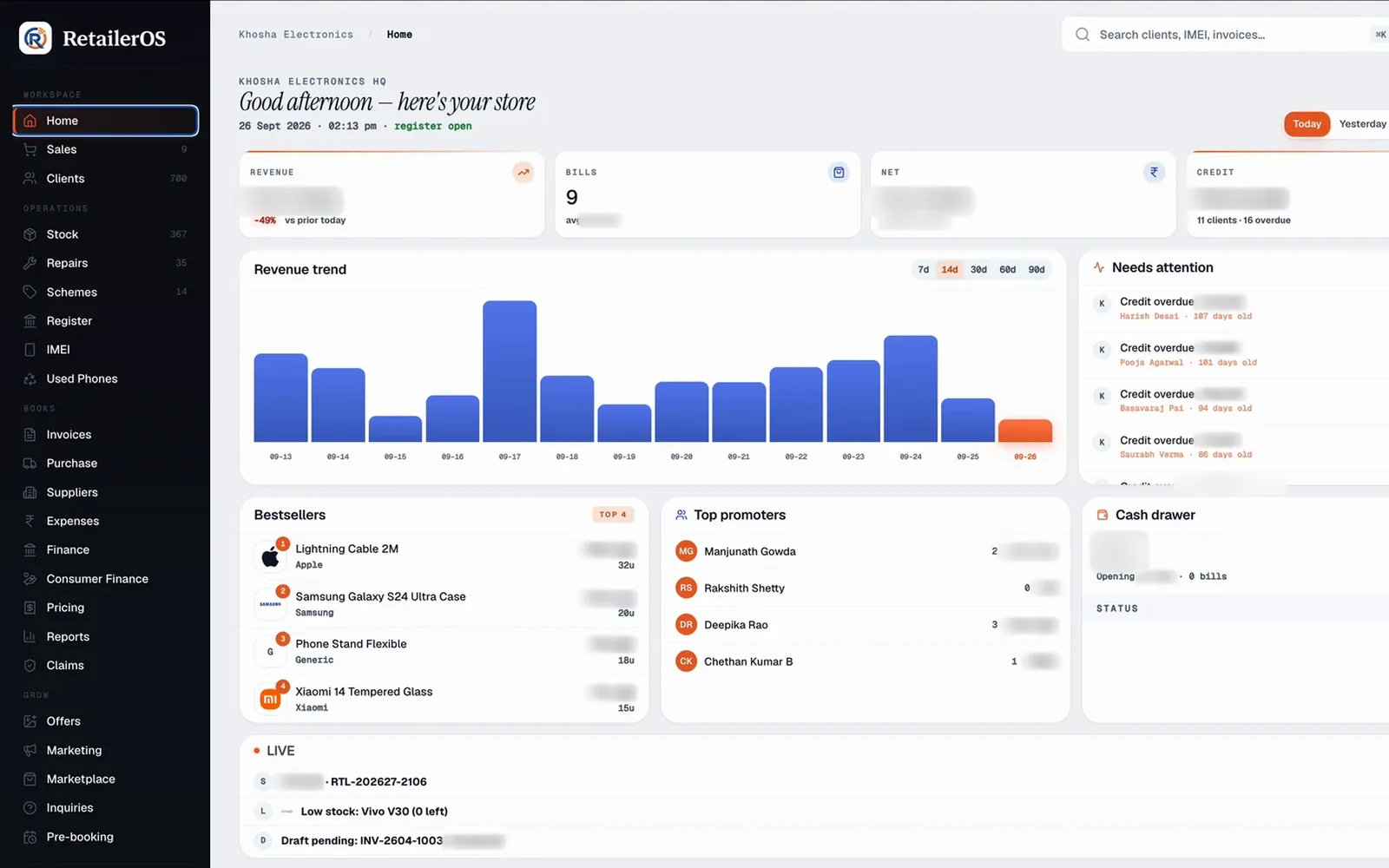
RetailerOS home: the store’s day, revenue trend, bestsellers, top promoters and the cash drawer (amounts hidden)
04

Mobile first, and forgiving of the network.

A counter has no IT team and no fibre line. RetailerOS is built to run on the retailer’s own phone and on a slow 2G connection, with every screen available in Hindi and three more languages, set per staff member. The same system puts the store online for its customers, with brands, categories and stock counts drawn from the live ledger.

  • Runs on slow 2G without complaint
  • Hindi and three more languages on every screen, per staff member
  • A ten-minute setup, no IT team
RetailerOS online store on a phone: the brands the shop carries, categories with stock counts and new arrivals

The store’s own online shop, served from the same stock ledger.

05

Automation, and where KAI comes in.

The scheduled work runs itself: a receipt on WhatsApp at payment, a repair status when it changes, a follow-up sequence after a sale, a reminder before a warranty ends. KAI, Khosha’s AI product, works alongside these systems. In RetailerOS it shows up where a counter needs it: describe an offer in plain words and the Marketing module generates the banner or post, ready to share on WhatsApp.

  • Post-purchase WhatsApp sequences, timed in days from the sale
  • Messages go out from the store’s own WhatsApp Business number
  • AI-generated creatives for festivals, launches and bank offers
The Automation module on retaileros.in (opens in a new tab)

Why brand schemes are hard.

A scheme is money a brand or a bank pays the retailer for selling a particular product in a particular window: a cashback, an exchange bonus, an instant discount, a bonus for crossing a target slab. Dozens run at once, they change weekly, and the margin on a handset is often in the scheme rather than the price.

Claiming one needs the product, the IMEI or serial, the scheme and the amount, for every eligible sale. Done by hand, that is a spreadsheet reconciled at quarter end, and whatever is missed stays with the brand.

₹15,000 to ₹40,000 a yearwhat a store that tracks schemes by hand typically leaves unclaimed, by our estimate.
  • One scheme catalogueFlat or percentage payouts, eligible brands and categories, start and end dates, and the full terms, entered once for every counter.
  • A brand target trackerSales against each brand’s target in rupees and units, with the incentive slab you are on and how far the next one is.
  • Applied on the billPick the scheme on the sale; the discount lands on the invoice and the sale is tagged to the scheme automatically.
  • Claims from real salesEvery scheme sale becomes a claim with product, IMEI or serial, scheme and amount, ready to file with the brand or distributor.
  • Nothing left unclaimedPending and settled at a glance, instead of a spreadsheet reconciled at quarter end.
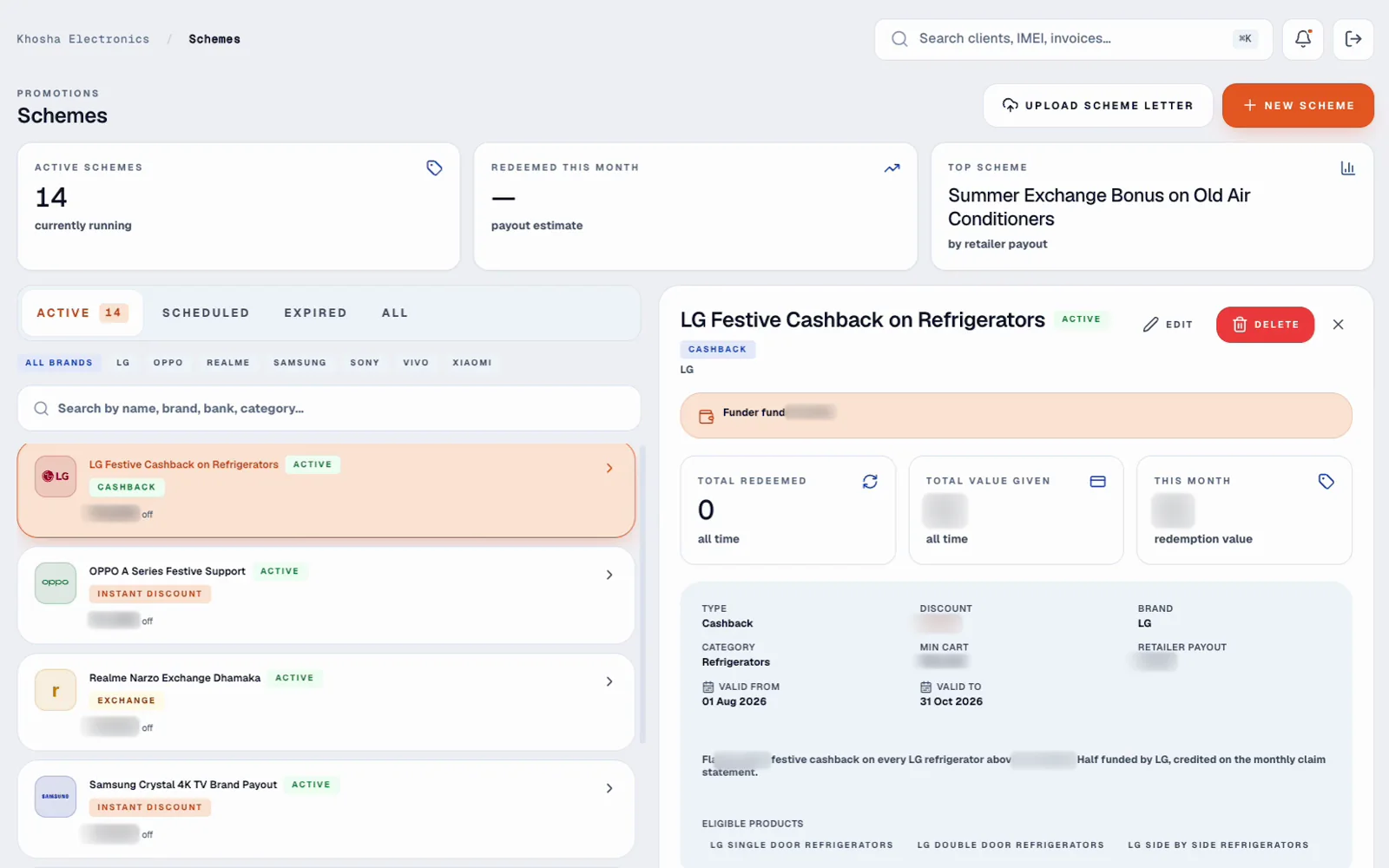
RetailerOS Schemes: active brand schemes from LG, Oppo, Realme and Samsung, with one festive cashback scheme open (amounts hidden)

Why a software company built a retail product.

Khosha Systems builds operating systems for real industries: Real Desk for real-estate sales, Passage for immigration practices, Liquor OS for liquor retail. RetailerOS is the one we run end to end, from the first line of code to the support line on WhatsApp.

That makes it our proof. When we say we study the layers of a business and then build software in the shape of its day, RetailerOS is where anyone can check the claim: twenty-three modules on one login, built around how an electronics counter actually works, used by retailers every day.

Every method we bring to a client engagement was tested here first: the layer-by-layer study, mobile-first engineering, a single live ledger, WhatsApp as the delivery channel, and KAI working inside a real workflow.

modules, one login
23
live ledger, every store
1
languages on every screen
4
  • PeopleStaffPromotersRoles per storeWho opens the counter, who approves the discount.
  • ProcessesRepairsPre-bookingPurchase OrdersA job card from intake to handover.
  • CustomersClientsKhaataInquiriesA name, a history, an open balance.
  • TransactionsSales DeskIMEI TrackerInvoicesWhat was sold, by serial, and how it was paid.
  • DecisionsReportsStoresFinanceWhat to reorder, what to push, which store leads.
  • ExperiencesWhatsApp receiptsOnline storeAutomationThe bill that arrives before the customer leaves.
Built for India

Explore RetailerOS, the product we built.

retaileros.in has the modules, the solutions by store type and a counter you can set up today. This page was the why. That one is the what.

Better systems for a more human world.

We're a team of six engineers, designers and strategists building systems together. Every business has layers, and every engagement has taught us how they connect. We engineer software that outlives the people who built it. If something here sounds like your business, we'd be glad to talk it through.

We use analytics cookies only if you allow them. Learn more